
Does reputation matter anymore?
From Catholic guilt to the attention economy, how shame and reputation continue to turn women against themselves.

Around the corner from my place in Brisbane there's an old house. It was once a commercial laundry run by the Catholic Church for unwed mothers who were forced to give up their babies and sent to work.
The building sits with indifference to its reputation, resting comfortably on a landscaped mound while a glossy housing development rises around it to conceal its dark history; a history shared through hushed conversations and conciliatory remarks like, “It was another time”. But was it?
Public shaming and humiliation, after all, thrived in the 90s and early aughts, only this time, the tabloids were the arbiters of moral outrage, spinning damsel and distress narratives for profit. It was the era of Gossip Girl, Mean Girls and reality tv, where popular culture pitted women against each other and female friendships were entered into with trepidation.
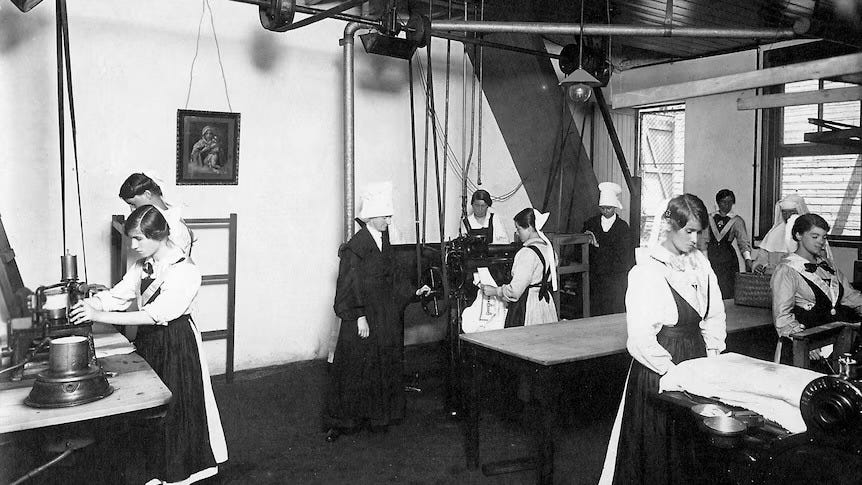
During this time, I attended a Catholic all-girls school. As far as I was aware, I had escaped the worst of it; there were no threats of ironing factories, or canes, or rickety music teachers waiting to slam the piano shut on my fingers at the sound of a wrong note. But the ‘good girl’ legacy was alive and well. Everyone knew once your reputation was sullied, it was irreparable. At a neighbouring school a “Burn Book” did the rounds - each girl’s name listed alongside her supposed failings. If it hadn’t come straight from the movie, you might admire the ingenuity.
We were gathered as a cohort and told a cautionary tale of a student who was urinated on at a party by a group school boys, with the underlying message that this could happen if we drank too much. We were routinely told that we needed to ‘act like ladies’ and I vowed never to be that girl - determined to sit in that neat and unattainable category between frigid and slut.
So I tried, I really did. I dutifully said my Hail Marys and accepted the wafer biscuit, chasing it down with crusty wine, hoping the ritual might erase the math equation I scribbled on the inside of my thigh to pass an exam. I solemnly said ‘Amen’, but I was sure the priest was onto me; the pang of catholic guilt for being both a sinner and a cheat.
I envied the girls who didn’t share my preoccupation with reputation, floating about the corridors with day-old mascara and smelling of male deodorant, while others yet to mature, buried their rebellion beneath fluffy key rings and anime posters. But my internal dialogue, by then, was fully outsourced to the imagined judgment of my teachers and peers.
With this as my backdrop, when I left school, I became fixated on reputation. Or more to the point, how to defend it, manage it and construct it. I studied law and decided that criminals were too far gone, unsavable as far as reputation goes. I would instead focus on proactively managing people’s reputation through press releases and carefully curated content.
And so I entered the world of public relations, with the motto being, Don’t allow others to tell your story - you tell it first. In a recent interview with Jessica Gardner, Monika Lewinsky recalls a professor giving her the advice that, “When a narrative is imbued with power, there needs to be a competing narrative.” And that in Lewinsky’s case, people with power had run away with her narrative.
I pestered journalists to gain coverage for startups, with garage-to-Silicon Valley type stories, burying any signs of trust funds or unspeakable privilege. For a time, I believed the myth-making was harmless. But after a while I grew tired of pushing false narratives, of consuming journalists’ finite resources to profile people who didn’t deserve the accolades. I watched as clients started to believe their own hero's journey - their appetite for coverage growing insatiable. In some ways it reminded me of The Picture of Dorian Gray - when outwardly their reputation gleamed but in reality they moved further towards moral decay. I warned that too much coverage was not the aim but steady coverage. Once people start looking for flaws, the risk is no longer obscurity but exposure.
And then something shifted. We moved into the attention economy where avoiding reputational damage came secondary to attention - good or bad. Exposure was good, no matter the reputational fallout.
In the past month Sydney Sweeney’s “my jeans are blue” commercial was received with anger and outrage, with some social media users arguing it gave credence to theories of racial superiority. In another time, this might have triggered panic amongst the American Eagle executives, but the company witnessed a 10% surge in sales after the ad was released.
We have reached a cultural inflection point, where the more extreme content is, the more platforms are able to profit from our para-social lust and anger. I often wonder whether Pamela Anderson, Lindsay Lohan and Kim Kardashian have resuscitated their reputation, not simply because of a collective reckoning with our past behaviour, but because their scandals seem relatively mild in an era of Bonney Blue (whose notoriety embodies a new extremity of fame and spectacle).
There’s no doubt social media has given celebrities tools to clap back and build communities, but it has also bred a culture where we feel entitled to access and retribution, punishing women who fail to perform for our attention. The instruments may have changed, but the logic endures; turning women against themselves in the name of reputation has, and always will, sustain the system.